
Tuesday, April 22, 2014

Sunday, October 20, 2013
Gamma Oryzanol

Introduction
Gamma Oryzanol ("Gamma-O") is a highly lipophilic sterol-like compound extracted from rice bran oil. It is used in various supplements with the belief that it increases testosterone by elevating Luteinizing Hormone (LH).
Evidence that it increases Testosterone or LH
In 1997, a placebo-controlled study was performed that examined gamma oryzanol supplementation in resistance trained men (1). The treatment group received 500 mg of gamma oryzanol for 9 weeks. Tested variables were 1 repetition max's of bench press and squat, as well as vertical jump power. No differences were seen between groups (placebo vs. gamma oryzanol). They also tested various laboratory parameters including testosterone, estrogen, cortisol, and cholesterol ratios. Again, no differences between groups were seen.
Is Lipophilicity a Problem?
Could lack of absorption be the reason why Gamma Oryzanol failed to effect testosterone and muscular strength in men? One of the most recent companies to market this product claims this is indeed the case. As a highly lipophilic compound, Gamma Oryzanol would need to be properly emulsified for gastrointestional absorption. A 1991 study found <5% absorption of phytosterols similar to gamma oryzanol when fed to rats by mouth (2). In order to circumvent the absorption problem, they then administered gamma oryzanol to rats through IV (intravenous) or subq (subcutaneous) and examined its effects on Luteinizing Hormone, and Growth Hormone (GH). Unexpectedly, they found that Gamma Oryzanol actually decreased LH, and GH. Interestingly, it also decreased the release of various catecholamines, including dopamine. The authors concluded:
"Although it hasn't been directly measured, this metabolic milieu...may actually reduce testosterone production."
Summary
- Gamma Oryzanol does not increase testosterone, or increase muscular strength in humans
- In rats, IV or subq administration actually decrease testosterone and growth hormone
- Its lack of absorption is probably a good thing
References
(1) http://www.ncbi.nlm.nih.gov/pubmed/9407258
(2) http://www.ncbi.nlm.nih.gov/pubmed/1844993
Friday, September 27, 2013
Sulbutiamine

Introduction
Sulbutiamine is a synthetic thiamine derivative designed to overcome thiamine’s inherently poor bioavailability. It was designed in the 70’s in Japan in response to widespread thiamine deficiency. Later studies revealed that it had a significant effect on treating asthenia, a type of centrally mediated fatigue.
Physiochemistry
Sulbutiamine is a lipid soluble analogue of thiamine which has been demonstrated to increase thiamine levels in tissue. Unfortunately, very little human pharmacokinetic data exists. Studies published from Servier, the French manufacturer of sulbutiamine, indicate that peak plasma levels of sulbutiamine...
Read more
Wednesday, August 14, 2013
Galantamine

Galantamine is by far my favorite nootropic. Not only is it a mild acetylcholinesterase inhibitor, it also positively modulates the alpha 7 nicotinine acetylcholine receptor. The end effect is a global increase in acetylcholine levels and the facilitation of the activation of the particular type of receptor intimately involved in learning and memory.
Acetylcholinesterase (AchE)
The strength of AchE inhibition is directly proportional to the reciprocal increase in the amount of acetylcholinesterase present. In other words, the stronger you inhibit the enzyme, the more the body produces to counteract its absence. This has been quantified in studies examining this effect with galantamine in comparison to donepezil, which saw much greater AchE enzyme elevation with donepezil. This isn't surprising since donepezil is roughly 40-300 times more potent at inhibiting this enzyme [1]. In the context of Alzheimer's disease, or other forms of dementia, this fact is relatively unimportant since the user will continue to supplement with the AchE inhibitor until death. Conversely, for a healthy individual using an AchE inhibitor for a relatively shorter amount of time, this may result in fairly significant rebound once supplementation ceases. This effect would be considerably more muted when supplementing with galantamine, especially since nootropic effects can be seen with doses much smaller then what is required to inhibit AchE.
Continue Reading
References
[1] http://www.ncbi.nlm.nih.gov/pubmed/15694923
Wednesday, July 10, 2013
Driven Sports Craze Adulterated with Meth Analog
It has long been suspected that Driven Sports Craze was spiked with an unlisted stimulant, although no one could have guessed quite how sinister the stimulant would turn out to be. In light of the AX Slim Xtreme controversy, it was widely assumed that if an insidious company owner would decide to spike one of their supplements, it would probably be with a non-phenylethylamine compound along the same lines as 1,3-DMAA. The latter compound is minus the benzene ring and therefore would be less likely to fall under the umbrella of the Federal Analog Act. Due to its structural dissimilarity, a non-phenyl derivative would also generate very little attention from of the FDA for at least a few years.
Not to be deterred by the thought of a lengthy prison sentence, the owner of Driven Sports decided to release an alpha-alkylated phenylethylamine nearly undetectable with most forms of drug testing. Not only does this compound produce low cross-reactivity while intact, but that its metabolites do not share overlap with conventional amphetamine metabolites - nor even ephedrine. The compound is called N, alpha-diethyl-phenylethylamine. It is 2 carbon atoms away from methamphetamine, and 1 ketone away from a popular bath salt. Overall, the alpha-ethyl substituent would produce less dopaminergic effects, while the N-ethyl group would marginally insulate the amine from rapid deamination. The end effect would be strong CNS effects, long lasting stimulation especially when coupled with caffeine, and with minimal addictive potential..
Background
In early 2012, Patrick Arnold tested Craze and found that it contained N-Benzyl-2-Phenylethylamine, in addition to another compound he could not positively identify without a reference (more on this later). When Patrick announced on various forums what he had found, he received notice from Matt Cahill's lawyers to cease public communication about Craze.
In retrospect, Matt Cahill's over-reaction to the news about Patrick's discovery should have been a huge red flag. After all, N-Benzyl-2-PEA is 1) found in nature and 2) extremely safe from being classified according to the Federal Analog Act. Instead of quieting speculation at the true contents of Craze, the legal notices simply fueled conjecture and skepticism. More importantly, however, is that the legal threats made adamant enemies out of those who would otherwise be indifferent.

In late 2012, supplement retailers in Australia began to receive notice from the Australian government that Craze was being restricted from import due to the presence of a "methamphetamine analog." Since the notices were not public record, the Driven Sports team easily deflected the charges as based on flawed testing procedures.

Coincidentally, also during this time period, the Australian Sports Anti-Doping Authority (ASADA) banned a professional rugby player named Troy Errington for using an extremely unique amphetamine analog that has only rarely been referenced in the literature. Interestingly enough, Mr. Errington placed blame on DS Craze. Indeed, Australia's National Measurement Institute confirmed the presence of the compound in Craze. Similarly, the Swedish government banned the importation of Craze into Sweden based on independent laboratory reports from the Swedish National Lab for Forensic Science.
While these stories were breaking, Patrick Arnold decided to re-test his Craze sample and match it to the referenced mass spec for this particular analog. Not surprisingly, it was a perfect match.

Driven Sports explanation for the magnitude of evidence against them involved an international counterfeiting conspiracy. (The Law of Parsimony may suggest that a counterfeiter producing a more effective product using a nearly untraceable designer stimulant is the height of absurdity, it did not detract from their legion of fans). They even had lab tests to prove their innocence. Despite no chain of custody for these tests, the tide of public opinion was swinging back in favor for Driven Sports.

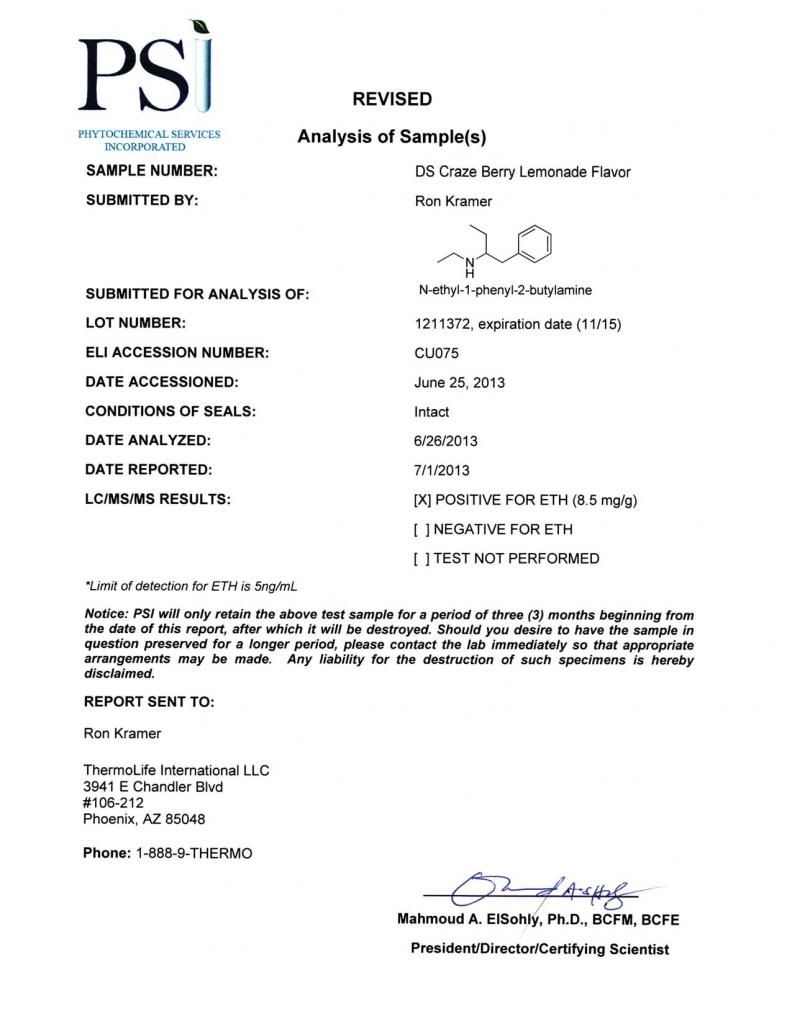
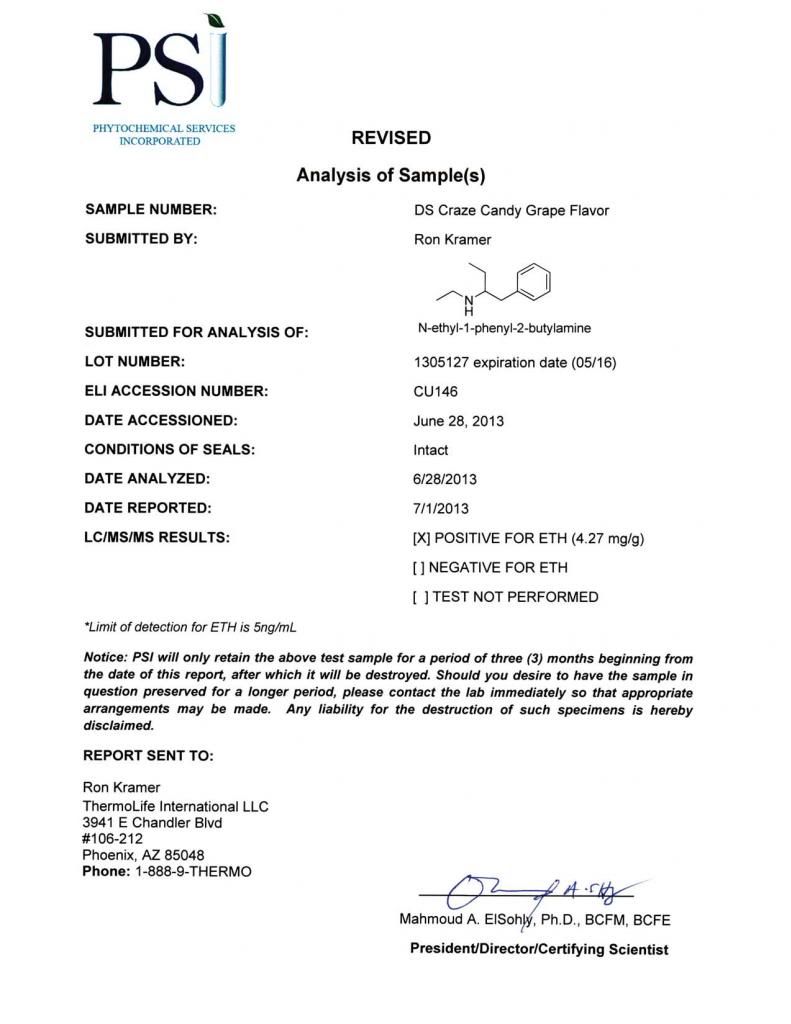
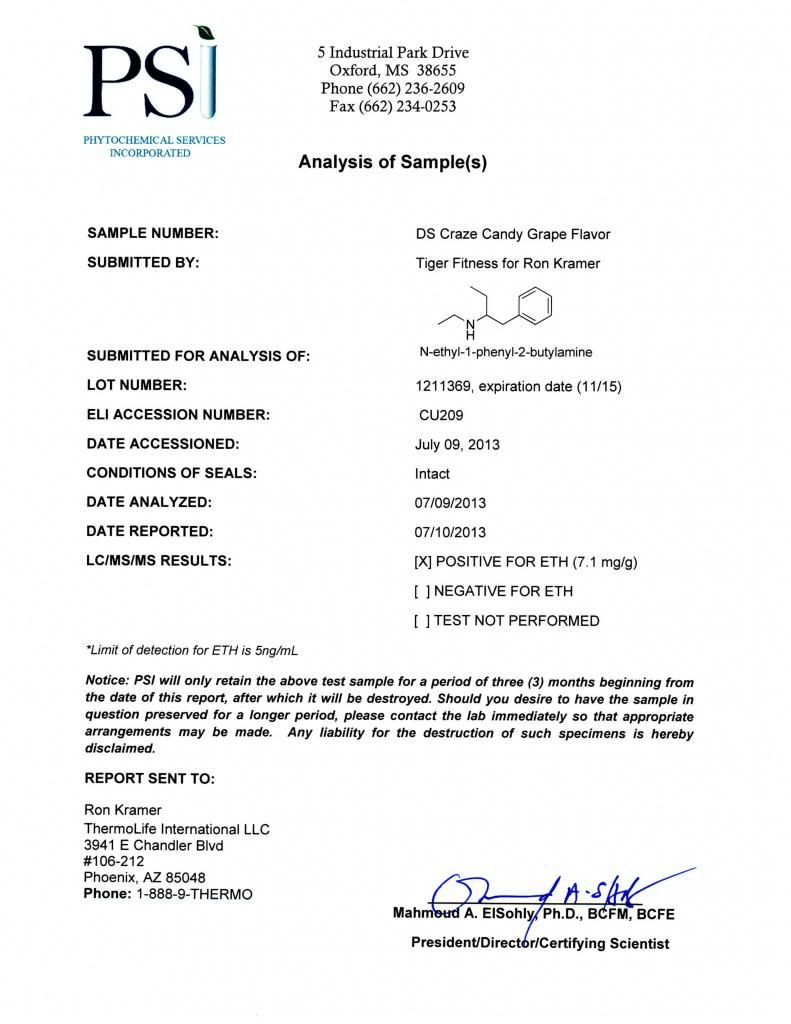
All of their excuses would come to light, however, when Ron Kramer of ThermoLife International would decide to produce a reference standard for this compound. According to Matt Cahill, the owner of Driven Sports, only they had a reference standard for N, alpha-diethyl-phenylethylamine, and therefore only they could prove or disprove its presence in Craze. (Although, one might wonder why they had a reference standard for it in the first place...). Now that Ron Kramer also had a reference standard, the truth could be explored more fully. No longer could Matt Cahill point towards an elaborate European counterfeiting scheme, since Ron Kramer would purchase his Craze samples directly from authorized dealers of Driven Sports in the United States.
In mid-June, Ron Kramer posted the first series of results from Craze testing:

Subscribe to:
Posts (Atom)